


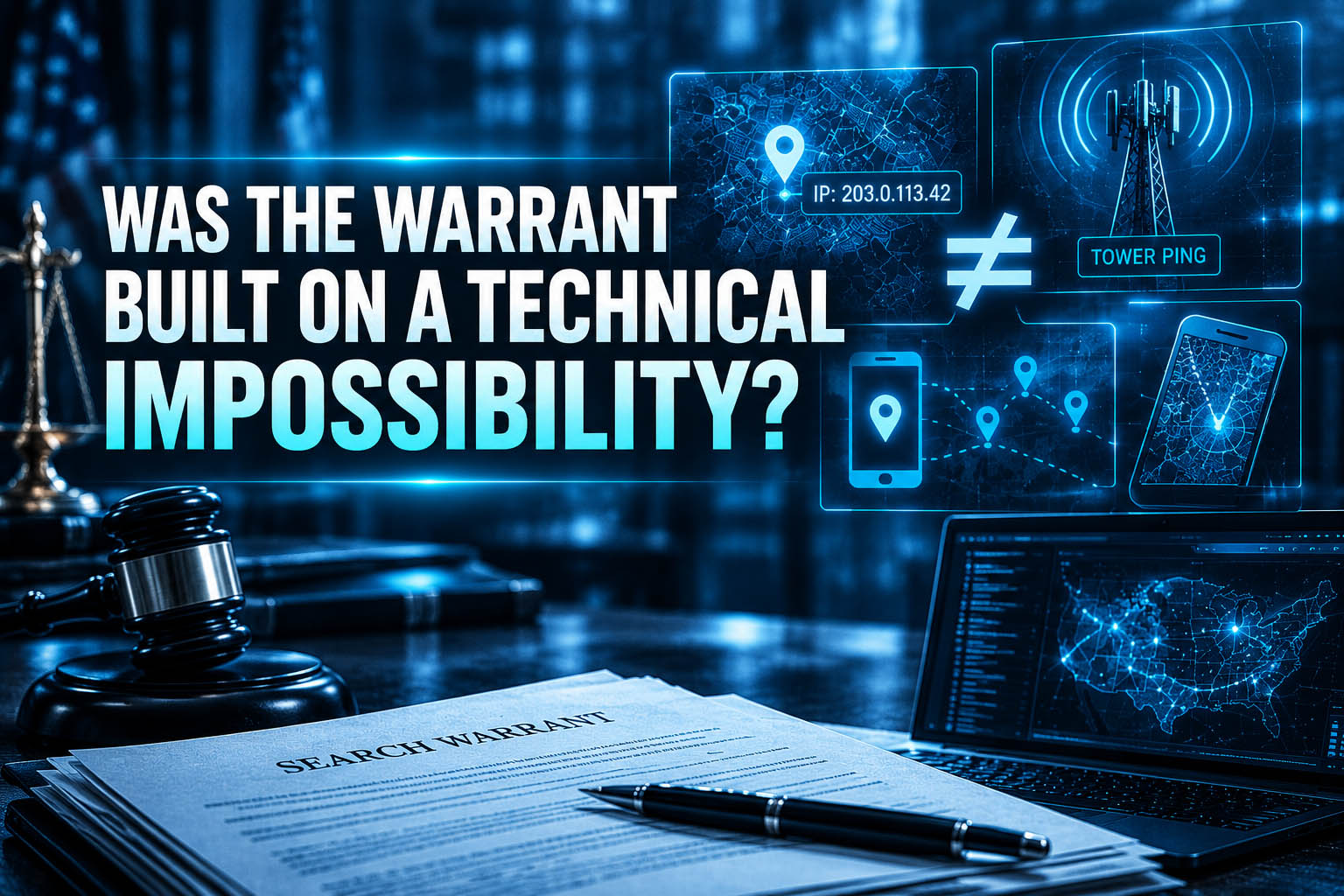
24 Oct Was the Warrant Built on a Technical Impossibility?
One of the first questions defense lawyers ask me isn’t about the phone at all. It’s about the warrant. Was it issued on technical claims that were actually possible, or on claims that only sound right to a judge reading an affidavit at the end of a long day?
It’s a fair question. Warrant applications are full of technical statements: this IP address belongs to the accused, this account was used from that house, this phone was at that location. The issuing judge hears one side, ex parte, with nobody there to say “that’s not how IP addresses work.” Those statements are rarely tested until defense counsel tests them.
In the US: the Franks hearing
Under Franks v. Delaware (1978), a defendant who makes a substantial preliminary showing that the affiant included a false statement knowingly and intentionally, or with reckless disregard for the truth, and that the statement was necessary to the finding of probable cause, is entitled to a hearing. If the falsehood is proven and what’s left of the affidavit doesn’t support probable cause, the warrant fails.
Courts have extended the same reasoning to omissions: facts left out with the intent to mislead the judge, or with reckless disregard of whether leaving them out would mislead.
In Canada: the Garofoli application
In Canada, the defence challenges the Information to Obtain (ITO) through a Garofoli application. The reviewing judge doesn’t ask whether they would have issued the warrant. They ask whether the issuing justice could have issued it on a corrected record. Under R v Araujo (2000 SCC 65) and R v Morelli (2010 SCC 8), misleading or erroneous information gets excised, minor good-faith errors can sometimes be corrected through amplification, and the warrant stands or falls on what remains.
Morelli is especially relevant to digital cases. The Supreme Court warned against ITOs padded with generalizations about what “people like this” typically do, instead of facts about the person and device actually under investigation.
The honest bar
These challenges are hard to win, and they should be. Errors in a warrant application, even serious ones, don’t automatically invalidate it. Courts look at the application as a whole. A Franks hearing in particular needs more than an allegation. It needs an offer of proof.
That’s exactly where a technical review earns its place. Saying “the IP evidence is weak” gets you nowhere. Showing, line by line, which technical claim was wrong, why it was wrong, and what the affiant knew or should have known, is what moves a judge.
The technical claims that fall apart most often
These are the statements I look for first in an affidavit or ITO, because they’re the ones most often stated with more certainty than the technology allows.
“The IP address belongs to the accused.” An IP address identifies an internet connection at a moment in time, not a person. It can point to a household router shared by everyone who lives there, a guest, a neighbor on an open Wi-Fi network, or a carrier that puts hundreds of customers behind the same address. Home addresses are often dynamically assigned and change over time. A VPN can make traffic appear to come from somewhere else entirely. And the subscriber the ISP names is whoever pays the bill, not whoever was typing.
“The ISP identified the subscriber.” That identification is only as good as the timestamp police sent the ISP. Platforms log times in UTC; ISPs often look up assignments in local time. Get the time zone wrong by a few hours on a dynamic address, and the ISP can hand back a different customer entirely. I always check whether the request and the response used the same clock.
“The account was used by the accused.” A login proves that someone had the password or an active session, not who. Shared devices, saved passwords, family accounts and compromised accounts all put activity on an account without its owner touching it.
“The phone was at the scene.” Cell tower records show which tower and sector a phone connected to. Depending on the area, that sector can cover a few blocks or several miles, and phones don’t always connect to the nearest tower. Tower data can put a phone in a region. Treating it like GPS puts it on a doorstep it may never have been near.
“The files were downloaded from the accused’s IP.” In file-sharing investigations, it matters exactly what police observed: a complete file transferred from that address, a fragment, or just a claim by the software that the file was available. Those are very different statements, and affidavits blur them.
“The extraction shows…” When an affidavit relies on an earlier phone or computer extraction, every problem in that extraction carries into the warrant: the extraction type, deleted-item flags, carved data, and timestamps that record a different event than the affiant assumed. If a Cellebrite report is quoted, the question is whether the affiant read it correctly.
Boilerplate about “people like this.” Paragraphs about what offenders of a certain type typically keep, hide or do aren’t evidence about this person or this device. In Canada, Morelli says that kind of generalization doesn’t belong in an ITO.
What the affiant left out
Misleading warrants often fail on what’s missing rather than what’s said. Things worth checking for:
- Other IP addresses tied to the same account that resolved somewhere else
- Other people living in the home or using the network
- An open or shared Wi-Fi network
- Corroboration police tried and didn’t get
- Records that pointed away from the accused
Courts don’t treat every omission as fatal. In one Ninth Circuit case, leaving out that an IP address was dynamically assigned didn’t earn a Franks hearing, because the ISP information still supported probable cause. The omission has to matter to the outcome. Finding the ones that do is the job.
What a technical review delivers
When I review a warrant affidavit or ITO, counsel gets every technical assertion pulled out and marked:
- Accurate: the claim holds up
- Overstated: true as far as it goes, but stated with more certainty than the data allows
- Unsupported: nothing in the disclosed material backs it
- Wrong: contradicted by the records or by how the technology works
For each problem, I note what the affiant had in front of them, what records would test the claim, and what was left out. The legal argument is counsel’s. My part is making sure it’s built on technical ground that holds when the Crown or prosecution pushes back.
Questions to ask about any warrant built on digital evidence
- Does the affidavit treat an IP address, account or device as if it were a person?
- Did the ISP request and response use the same time zone?
- Is tower data being described as a precise location?
- What exactly was observed in any file-sharing claim: a full file, a fragment, or availability?
- Does the affidavit rely on an extraction, and was that extraction read correctly?
- Which paragraphs are generalizations rather than facts about this case?
- What did police know that isn’t in the affidavit?
The takeaway
Warrants get issued on technical claims nobody in the room was equipped to question. That doesn’t make them wrong, but it makes them worth checking. If a warrant in your case rests on IP addresses, accounts, tower data or a prior extraction, the technical claims deserve the same scrutiny as everything else.
If a warrant in your case rests on digital claims, I offer a technical review of the warrant affidavit or ITO. It starts with a flat-rate TruthScan that tells you which claims hold, which don’t, and whether a Franks or Garofoli challenge has technical footing.
Sources
- Franks v. Delaware, 438 U.S. 154 (1978): summary
- Overview of Franks hearings and omissions in federal cases (Silverman Thompson)
- United States v. Martinez (9th Cir. 2017): dynamic IP omission
- Challenging search warrants under Canadian law: excision and amplification (Robichaud Law)
- R. v. Payne, 2024 NSPC 12: Garofoli review applying Araujo and Morelli
- R. v. T.R.S., 2024 YKSC 17: Morelli generalizations in an ITO