


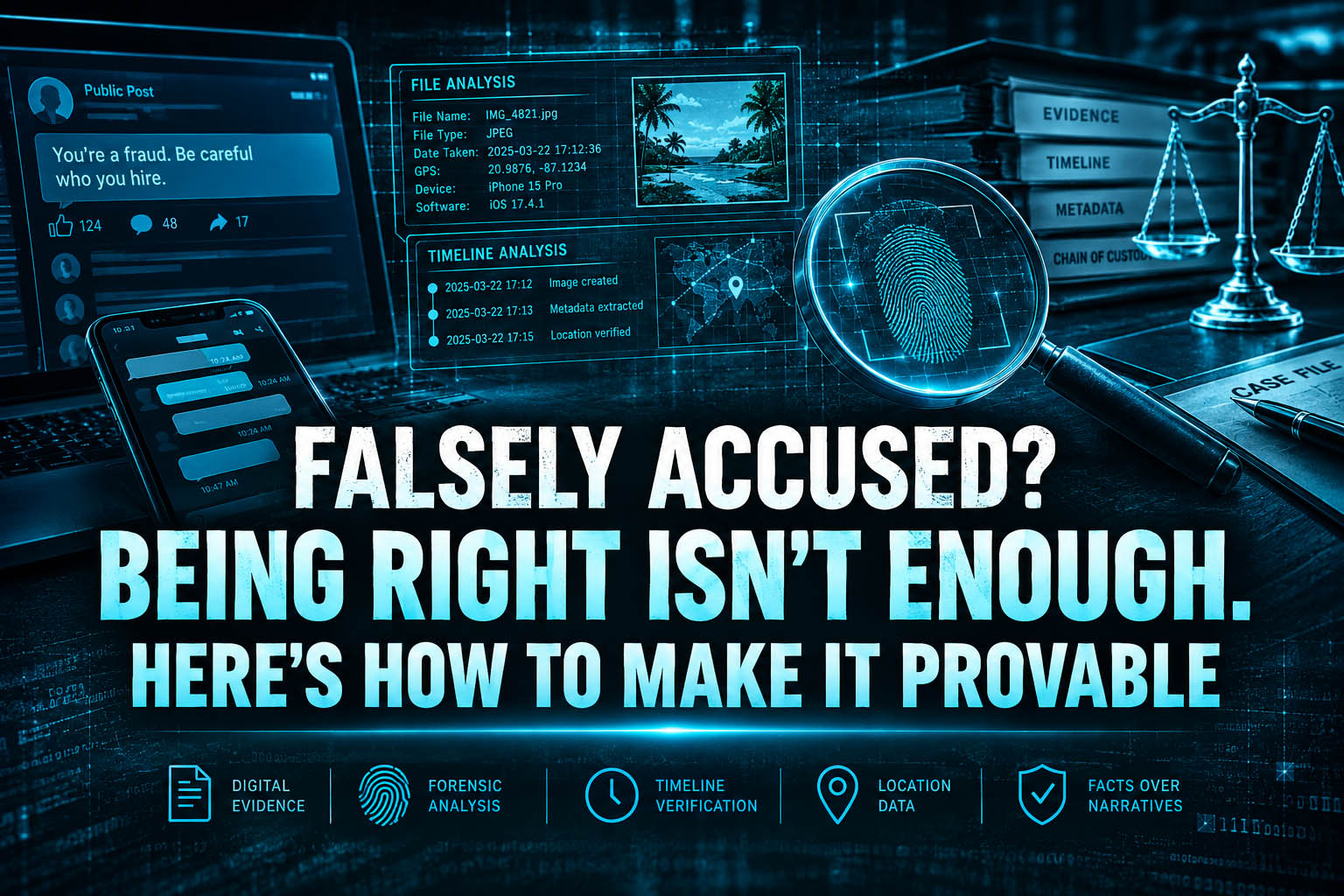
01 May Falsely Accused? Being Right Isn’t Enough. Here’s How to Make It Provable
When I was falsely accused, I assumed the truth would be enough. I knew what happened. I had messages, screenshots and dates. I figured that once people saw them, it would be over.
It wasn’t. Most people had already picked a side, and nobody wanted to look at what I had. What I had also wasn’t organized in a way that would make them. It never went near a courtroom, and it still taught me the lesson that runs my practice now: being right and being provable are not the same thing.
If your situation is headed for court, through a criminal charge, a protection order or a custody fight, that lesson matters even more. Courts are stricter than the court of public opinion, not looser.
Courts don't run on stories
It feels like a clear enough explanation should settle things. It doesn’t. Courts are built to be skeptical. Every claim gets tested against documents, corroboration, consistency and cross-examination, and whatever fails gets set aside no matter how compelling it sounded.
That cuts both ways. The other side’s story gets the same treatment, if someone makes it face the test. Your job is to make sure the record, not the loudest version of events, decides the outcome.
Credibility in that setting isn’t emotional. It’s structural. Do the records line up? Do the dates hold? Do your statements stay consistent? Does the evidence make sense without you standing next to it explaining? If your case depends on being understood, it’s fragile. If it depends on being supported, it holds.
Memory and certainty work against you
Memory feels reliable from the inside. It isn’t. It shifts under stress, over time and with retelling, and two honest people can remember the same night differently.
Strong emotion makes it worse. The more something hurt, the more certain we feel, and certainty fills gaps the evidence hasn’t filled. That’s how people end up saying “this proves everything” about something that proves one small thing. Overstatement is easy for the other side to knock down, and when they do, your credibility goes with it.
Digital evidence isn't the truth either
People swing to the other extreme and treat their phone as the final word. It isn’t. Digital systems record activity: a message was sent, a file was changed, an account was accessed. They don’t record intent, tone, or what anyone believed at the time.
A message can be real and still misleading. A screenshot can be untouched and still leave out the part that changes its meaning. Metadata can be accurate and still be read wrong. Digital evidence doesn’t lie, but people lie with it constantly, and the same data can be used against you if you present it carelessly.
Unprovable doesn't mean false
This matters for your own sanity. A lack of proof doesn’t mean something didn’t happen. Events happen privately. Records get lost. Nobody thought to document anything. The same goes for the accusation against you: the fact that someone can’t prove you didn’t do something doesn’t make it true.
The question to keep asking is narrow and practical: what can actually be shown? That’s the question the rest of this article answers.
How to make the truth provable
None of this replaces your lawyer. It’s what to do alongside them, starting now, so they have something solid to work with.
- Freeze your devices and accounts. Don’t delete anything, including messages that embarrass you or threads you’d rather forget. Don’t factory reset or replace your phone. Deletion looks like guilt, and it destroys the records that can show what really happened, or prove the other side’s version was edited.
- Get the full record, not screenshots. Screenshots are fragments. Most apps let you export whole conversations, and most platforms let you download your account data. A full export carries dates, sequence and context that a screenshot never will.
- Write a dated timeline now. While your memory is fresh, write down what happened in order: dates, times, places, who was there, what was said. Mark which parts you can back with a record and which parts are memory only. That second column tells you where the work is.
- Pull the official records. Bank statements, phone bills, utility accounts, employer records, travel bookings, receipts. Official records are hard to argue with because nobody created them for the dispute. When someone publicly accused me of leaving tenants without power, I didn’t argue online. I pulled the utility statement, and the dates settled it.
- Find independent corroboration. Who else saw it? What other record touches the same moment, like a location history, a call log or a card transaction? Evidence that comes from somewhere other than you carries far more weight.
- Stay off social media about it. Don’t post, don’t reply, don’t confront. Every word becomes part of the record, and an online fight helps the side with the louder story, which is rarely the side with the better evidence.
- Hand it all to your lawyer, organized. A clean timeline with records attached is worth more than a thousand screenshots in a folder.
Say less, and say it precisely
The people who come across as credible in court rarely sound dramatic. They say “this shows,” “this is consistent with,” “this part we can’t confirm.” They separate what’s proven from what’s likely and what’s unknown.
That restraint isn’t weakness. It’s what makes the strong parts believable. Claim exactly what your evidence supports, and nothing the other side can take apart.
The takeaway
Knowing what happened is where it starts, not where it ends. The truth needs a structure that holds up when someone who’s never met you looks at it cold. Build that structure early, before memories fade, accounts get closed and the other side’s version settles in.
If you’re facing an accusation built on messages, screenshots or digital records, a TruthScan is a flat-rate review that shows what your evidence actually supports. I work alongside your lawyer, so bring them in, or have them contact me directly.