


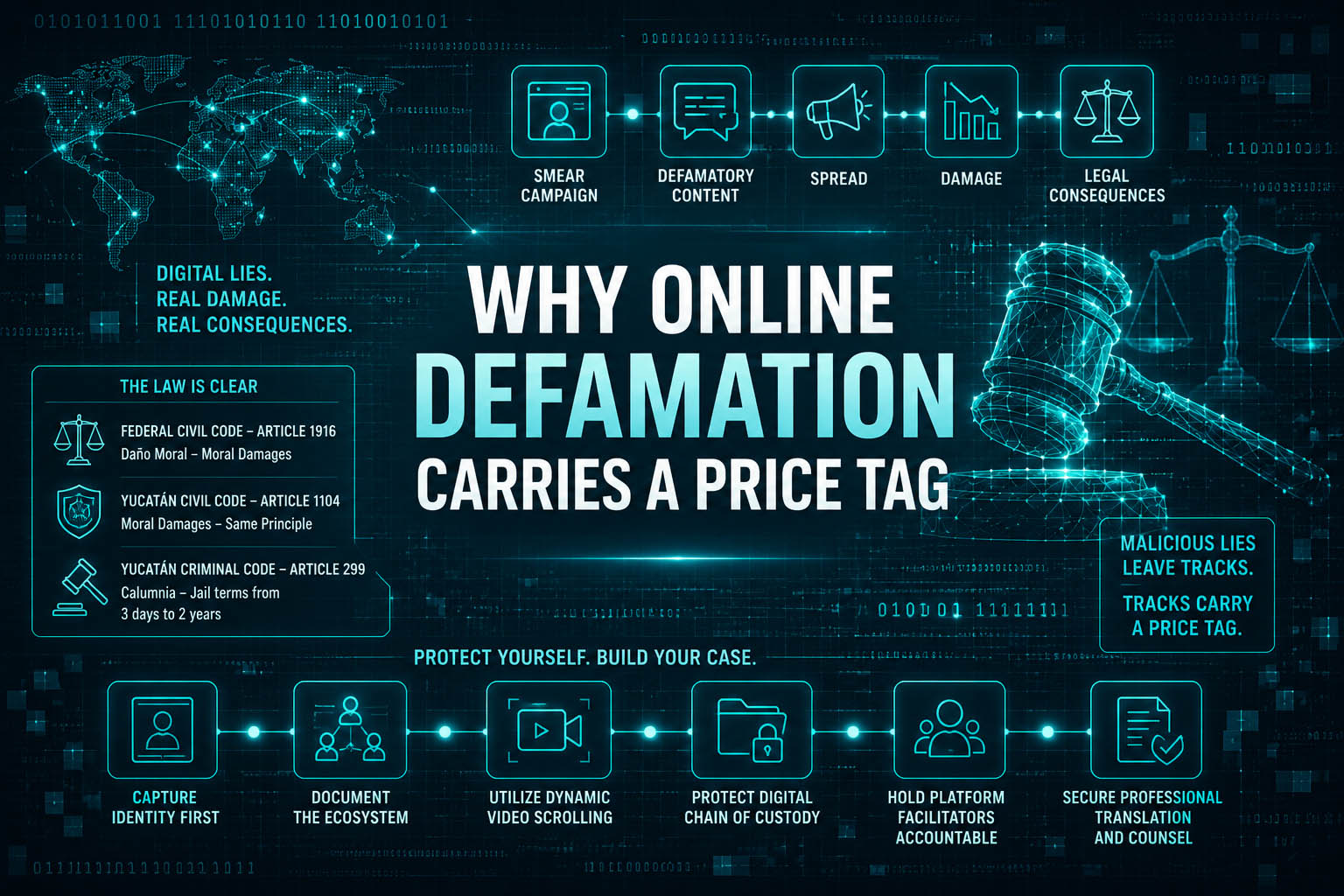
06 Jun Why Online Defamation Carries a Price Tag
Some people have a mistaken belief.
They think that if they don’t get what they want, when they want it, they can go online and smear people with impunity.
They treat the digital landscape like the Wild West.
It isn’t.
Malicious lies leave tracks. And tracks carry a price tag.
The civil side: Daño Moral
If you are targeted by someone operating within Mexico, or if you are protecting an asset here, the law is explicit.
Article 1916 of the Federal Civil Code addresses this directly through Daño Moral, or moral damages.
It dictates that anyone who violates the honor, reputation, or private life of another through illicit acts must provide financial compensation.
In Yucatán, Article 1104 of the State Civil Code reinforces the exact same principle.
The consequences can be substantial, including significant financial damages depending on the facts of the case.
The criminal side: Yucatán’s unique exception
Many people assume that defamation is entirely a civil matter across all of Mexico.
They are wrong.
While the federal government decriminalized crimes against honor in 2007, Yucatán remains a striking exception where it is still actively pursued as a criminal offense. The Fiscalía General del Estado (FGE) does not treat this as a dead letter—local control judges routinely hand down indictments and enforce severe precautionary measures, including state travel bans and restraining orders, long before a case even goes to trial.
The Yucatán Penal Code provides teeth to the law:
- Artículo 294 (Injuria / Insult): Penalizes any expression or action executed to manifest contempt with the intent to offend. It carries a penalty of three days to two years in prison.
- Artículo 295 (Difamación / Defamation): Covers maliciously communicating a fact to cause dishonor or discredit. It carries three days to two years in prison.
- Artículo 299 (Calumnia / Slander): Specifically penalizes falsely accusing someone of a specific criminal offense, carrying a prison sentence of six months to two years.
The legal remedies exist. But moving a case from an online rant into a criminal prosecution requires clearing an incredibly high evidentiary bar.
Clearing the legal bar to prosecution
To get the Fiscalía to act and a judge to indict, your evidence must structurally dismantle the defenses the perpetrator will throw up. Under Yucatán law, you must clear three specific hurdles:
- Proving Ánimo de Dañar (Malicious Intent): Under Article 296, a defendant is exempt from liability if they claim they were acting out of a “legitimate duty” or simply sharing an opinion without a specific intent to harm. To break this defense, you must prove dolo (reckless malice) through a documented pattern of behavior.
- The Specificity of Calumnia: Calling someone “corrupt” or a “thief” in a generic online argument usually defaults to a minor insult (injuria). To stick a criminal calumnia charge, you must prove they falsely accused you of a specific, defined crime knowing you were innocent.
- The “No-Excuse” Shield (Article 305): Perpetrators always claim, “I didn’t invent the rumor, I just copy-pasted it,” or “Everyone else was sharing it.” Yucatán law explicitly crushes this excuse. Article 305 states that anyone who replicates or shares a defamatory statement is legally treated as an active author of the crime.
Evidence requires precision
I have spent decades in the IT and digital forensics field.
I have been court-approved on numerous occasions to consult on trial strategy, engineer cross-examination lines for opposing witnesses, and deliver expert testimony.
Some of those cases remain sealed to this day.
I do not offer legal advice. I am an investigator.
But I know exactly what it takes to build a digital case file that clears these legal bars.
If you are currently facing a targeted digital attack, you cannot afford to panic. You must document. Here is the tactical framework required to protect your reputation and build a defensible case.
Capture identity first
Do not just screenshot the defamatory comment or post. Navigate directly to the primary account profile of the person posting the lies. Capture everything you can see about their digital identity: Profile URLs, account creation indicators, unique handles, and listed details. This is vital to establish a clear technical link between the content and the physical actor.
Document the ecosystem
Because Yucatán’s Article 305 holds anyone who shares a defamatory post criminally liable, you must document the entire ecosystem. Take captures of the reactions, the comments, and every single share. Tracking who hit “share” or copy-pasted the narrative into secondary local groups gives your legal team the data needed to expand the circle of liability and calculate total civil damages.
Utilize dynamic video scrolling
Screenshots feel convincing to you, but they are fragile in a legal dispute. Opposing parties routinely claim they were manipulated or cropped. Take it a step further. Use a screen recorder to record a continuous video. Start from the main app interface, show the headers, and scroll slowly through the entire thread. A continuous, unedited video scroll is exceptionally difficult for an opposing technical witness to dispute.
Protect the digital chain of custody
Do not delete, compress, or alter the original files on your device after you capture them. Maintain the pristine originals exactly on the device where they were generated to preserve system-generated metadata and timestamps. Without metadata, reconstructing an unassailable chronological timeline for the court is nearly impossible.
Issue administrative notices to lock in Ánimo de Dañar
If the defamation is occurring inside a localized forum, such as a community Facebook Group, message the administrator or owner directly. Request that the content be removed to mitigate further harm. Screen-capture your request and their response.
This step is a tactical trap. By proving they were explicitly notified of the harm and chose to leave it up, you mathematically destroy their defense of “having no intent to harm.” You lock in the ánimo de dañar required for criminal prosecution.
Secure professional translation and forensic structure
Dumping unorganized screenshots on an authority figure rarely works. Get a strong lawyer, present your structured evidence, and file a formal querella (complaint) directly to the Fiscalía General del Estado.
If you are a non-native speaker, ensure any English text is processed by a certified legal translator (Perito Traductor) so your evidence translates seamlessly into the local system. Furthermore, to ensure your digital timelines and metadata reports are fully admissible, your legal team will utilize a certified forensic expert (Perito en Informática Forense) to formally ratify the data structure.
Why data beats noise
Smear campaigns rely entirely on psychological momentum. They assume you will collapse under the emotional weight of the noise before you can build a defense.
Do not allow the noise to distract you. Keep your head down and capture everything.
When you are defending your freedom, your livelihood, or your name, sincerity is not enough. Courts do not judge sincerity. They test documentation. If your evidence cannot stand on its own without your explanation, it is vulnerable.
You are not alone. You are not without recourse.
This is not the Wild West. Don’t be afraid to look the noise in the face and fight back with data.
Final thought
Lies are fast, loud, and messy.
Facts are slow, quiet, and structured.
But structured facts outlast loud narratives every single time.
If you are currently sifting through an overwhelming mountain of screenshots, defamatory posts, or digital attacks and don’t know if your data will hold up to the high bars of the Yucatán legal system, start with a TruthScan. One review. One report. Clear next steps.