

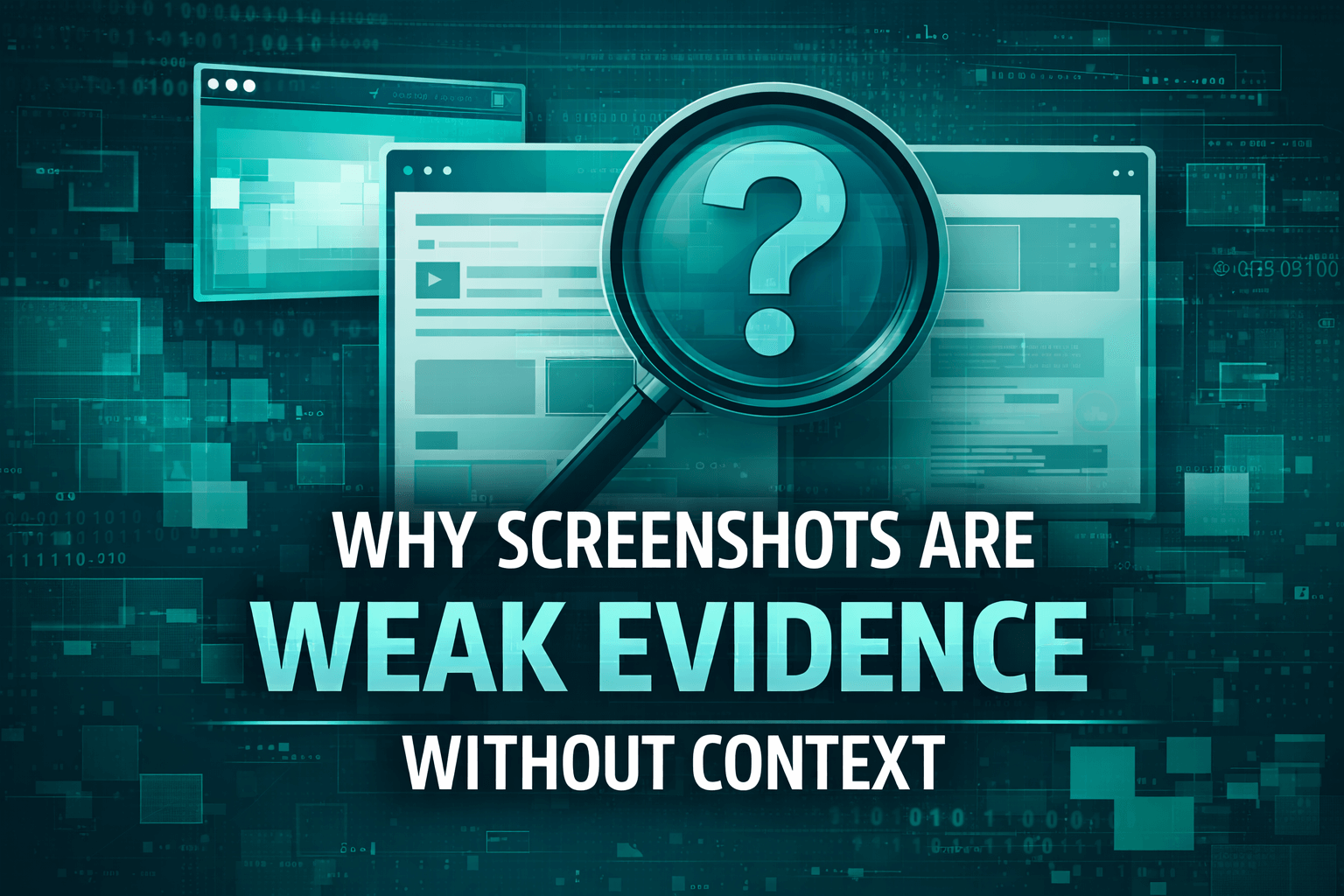
31 Dec Why Screenshots Are Weak Evidence Without Context
Screenshots feel convincing. They look like proof. They feel concrete. They seem final.
But in serious disputes, screenshots are often some of the weakest evidence you can bring forward.
That surprises people. It shouldn’t.
Why screenshots feel persuasive
A screenshot captures a moment. It freezes a message, an image, a post, or a transaction in time. When you look at it, your brain fills in the rest of the story automatically.
You remember what led up to it.
You remember what happened after.
You remember how it felt.
The problem is that none of that memory travels with the image.
To anyone outside your head, a screenshot is just a fragment. And fragments are easy to misread, misframe, or dismiss.
Screenshots lack provenance
One of the first questions any serious reviewer asks is simple:
Where did this come from?
A screenshot does not answer that question on its own.
It does not show:
- The original source file
- Whether it was edited or cropped
- What device created it
- When it was captured versus when the event occurred
- What happened before or after
Without provenance, a screenshot is an orphaned artifact. It exists, but it is not anchored to a reliable chain of events.
That makes it fragile.
Context is where meaning lives
Meaning does not live inside a single image. It lives in sequence.
- A message that looks threatening in isolation may be defensive in context.
- A message that looks calm may follow days of pressure.
- A message that looks incriminating may be a response to provocation that is no longer visible.
Screenshots remove sequence by default.
When context collapses, interpretation takes over. And interpretation is where disputes go sideways.
Screenshots are easy to manipulate
This is not speculation. It is routine.
Screenshots can be:
- Cropped to remove key information
- Reordered to imply a false sequence
- Taken from test environments or alternate accounts
- Modified subtly without obvious visual artifacts
Even unedited screenshots can mislead if they are selectively presented.
Courts, employers, and investigators know this. That is why screenshots alone rarely settle anything.
Metadata matters more than appearance
What gives digital evidence weight is not how it looks. It is what sits underneath it.
Metadata can reveal:
- Creation timestamps
- Modification history
- Device information
- File lineage
- Platform-specific markers
Screenshots often strip or obscure this data. Once metadata is gone, it cannot be reconstructed from the image itself.
This is why professionals always ask for originals, exports, or device-level data when possible.
Timelines expose distortion
One of the fastest ways to test a screenshot’s reliability is to place it inside a timeline.
When you map:
- Messages before and after
- Gaps in communication
- Overlapping events
- Repeated patterns
You start to see whether the screenshot fits or clashes with reality.
Manipulation rarely survives timelines. Inconsistencies surface quickly when events are placed in order.
Why belief is not enough
Many people say some version of this:
“I know it’s real. I was there.”
That may be true. It is also irrelevant to systems that require proof.
Courts, HR departments, and institutions are not built to evaluate sincerity. They evaluate documentation.
If your evidence cannot stand on its own without your explanation, it is vulnerable.
When screenshots backfire
There is another risk people underestimate.
Screenshots can be used against you.
If opposing parties show that:
- Context was omitted
- Sequence was altered
- Supporting data was ignored
Your credibility takes the hit, not just the artifact.
At that point, even strong evidence elsewhere may be viewed with suspicion.
What actually strengthens a screenshot
Screenshots are not useless. They just need support.
They become stronger when paired with:
- Platform exports or logs
- Device-level data
- Consistent timestamps
- Corroborating messages
- Clear, documented timelines
In other words, screenshots work best as illustrations, not foundations.
Clarity beats volume
Dumping hundreds of screenshots rarely helps. It usually hurts.
What works is selection, structure, and explanation that does not rely on emotion.
The goal is not to overwhelm. The goal is to make distortion impossible.
Start with reality, not assumptions
Before you argue about what something means, you need to know what it actually proves.
That distinction saves people time, money, and unnecessary damage.
If you are unsure whether your screenshots help or hurt your position, that uncertainty is a signal worth listening to.
Final thought
Screenshots feel like truth because they look simple.
Reality is rarely simple.
If you want clarity, start with context. Everything else follows.
If you are unsure what your evidence actually proves, start with a TruthScan. One review. One report. Clear next steps.