


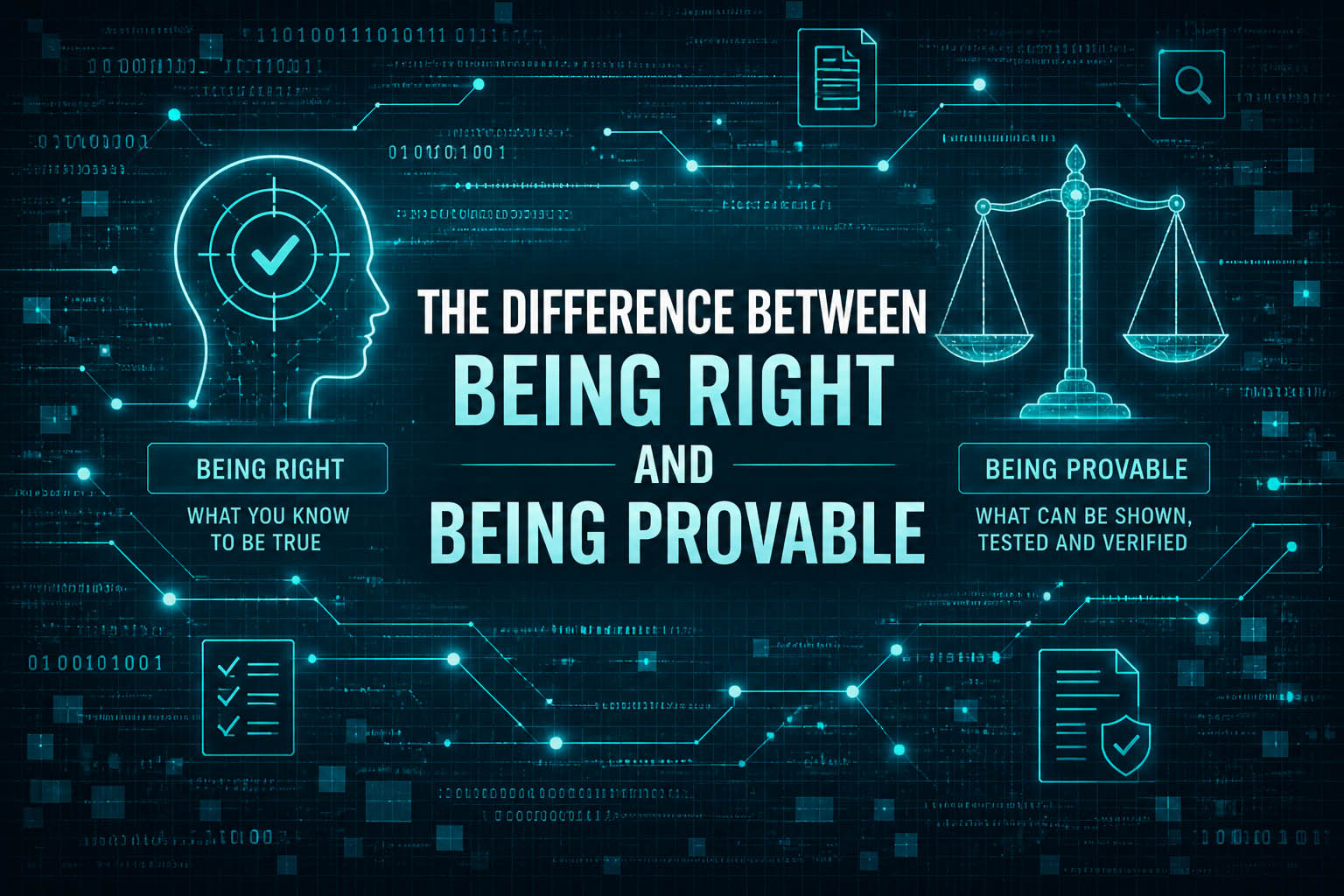
01 May The Difference Between Being Right and Being Provable
One of the hardest lessons people learn in conflict is this:
Being right is not the same as being provable.
You can know something happened.
You can remember it clearly.
You can even have people who believe you.
That still does not mean you can prove it in a way that survives scrutiny.
This is where emotion and structure separate.
Reality exists independently of proof
Something can be true without being demonstrable.
People struggle with this because it feels unfair. If something happened, surely the truth should be enough.
But systems do not evaluate internal certainty. They evaluate external support.
That means:
- Some true claims fail
- Some incomplete claims succeed
- Some events leave almost no usable trail at all
Proof is not reality itself. It is a structure built around reality.
Memory is not evidence
Human memory feels reliable from the inside.
It is not.
Memory shifts:
- Under stress
- Across time
- Through repetition
- Through interpretation
Two people can remember the same event differently without either one intentionally lying.
This is why institutions do not rely on recollection alone. They rely on documentation, consistency, and corroboration.
Strong feelings create false certainty
The more emotionally charged an experience becomes, the more people assume clarity follows automatically.
Often the opposite happens.
Emotion narrows focus.
It fills gaps.
It creates narrative cohesion where evidence may still be incomplete.
This is why people sometimes mistake conviction for proof.
They are not the same thing.
Evidence must survive outside your perspective
Real proof has a difficult requirement.
It must remain persuasive even when removed from your emotional experience.
That means:
- The timeline holds without explanation
- The records align independently
- The sequence makes sense externally
- The evidence supports itself
If everything depends on you interpreting it for others, the structure is weak.
Why people overstate their cases
When someone feels deeply harmed, they often push beyond what the evidence can actually support.
This usually sounds like:
- “This proves intent”
- “There’s only one explanation”
- “Anyone can see what happened”
But evidence rarely works that cleanly.
Good analysis separates:
- What is confirmed
- What is likely
- What remains uncertain
That restraint is what lends to credibility, not weakness.
Legal Institutions reward structure, not passion
Courts, employers, investigators, and review panels are not built to process emotional intensity.
They process:
- Documentation
- Sequence
- Consistency
- Corroboration
This frustrates people because emotional truth can feel more real than technical structure.
But systems do not operate on emotional force. They operate on demonstrable support.
Being unprovable does not mean being false
This is important.
A lack of proof does not automatically mean something did not happen.
It may mean:
- Evidence was lost
- Events happened privately
- Documentation never existed
- The structure is incomplete
Understanding this prevents two dangerous mistakes:
- Assuming every claim is true
- Assuming every unprovable claim is false
Reality is more complicated than either extreme.
Final thought
Being right may matter personally.
Being provable is what matters structurally.
If you confuse the two, frustration becomes inevitable.
Clarity begins when you stop asking, “What do I know happened?” and start asking, “What can actually be demonstrated?”
That is where serious analysis begins.
If you need to understand what your evidence actually supports, start with a TruthScan.
One review. One report. Clear next steps.